Noted
The Power To Say No
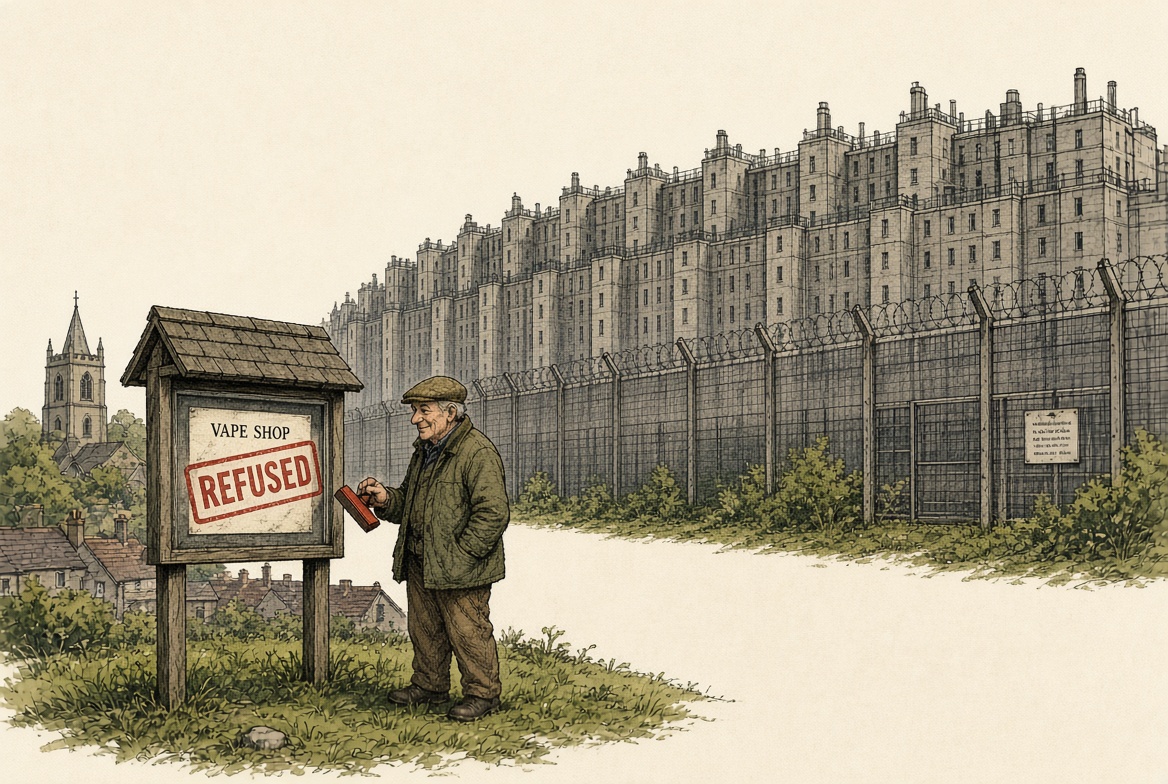
The Prime Minister on Piddington, Oxfordshire — a village of roughly 400 people, now to have a 1,200-place asylum camp at a disused barracks nearby:
"We cannot have a situation where it's only the poorest communities in the country that receive all of the dispersal of refugees and asylum seekers. I do believe all parts of the country need to work, to play their part." Look at what playing their part means here: three arrivals for every existing resident. That is not a share of the burden. It is the replacement of a village.
And the question of fair distribution is downstream of a question nobody in government will answer.
Why is any of this dispersal at all?
Consider the cases this paper has already reported. In Epping, a man living in the hotel was convicted of sexual offences, including against a fourteen-year-old girl. In Heywood, a man who had been refused asylum three times was arrested at a school with a hatchet, a hammer, a knife and a can of petrol; the sentencing judge criticised the Home Office for the state of his immigration status.
Neither man was a prediction. Both had been processed by this system, and both were living freely in an English town when they did what they did.
The answer to that is not a better postcode. It is that people who arrive undocumented should be held securely while their identity and claim are established, and that those refused should be removed. Detention and removal are not exotic demands. They are what most people assumed the system already did.
Instead we have dispersal — the quiet redistribution of an unresolved problem, moved from town to town according to which places have room and which have the least ability to object. Fairness in dispersal is a debate about how to share a failure more evenly. It is not a plan to end it.
Piddington's residents are preparing a symbolic referendum to declare independence. It has no legal force, which is the point. Epping used the real instrument — the High Court — lost twice, and was ordered to pay the Home Secretary's costs. A pretend referendum is not less sensible than that. It is simply cheaper, and about as likely to work.
Here is the sentence that ought to end this argument, because the Prime Minister wrote it himself this week.
Launching his summer tour, in a piece on reviving Britain's high streets, he described his reforms as "giving local people something they lost a while back: the power to say no." He went further: local leaders would get "the power to say no to what doesn't belong on their high street, and the tools to fix it themselves."
He is right that it was lost, and right that it should be returned. He simply does not mean it.
Because a village may now say no to a vape shop, and may not say no to a camp three times its own size. The power to say no has been granted precisely where it costs the government nothing and withheld everywhere it would cost them something. That is not devolution. It is a pocket-money allowance — real currency, spendable only in the gift shop.
And it is the same failure we keep arriving at from every direction. Epping said no through the High Court and was billed for it. Piddington has been reduced to a pretend referendum because no real one exists. The people of this country are permitted to object to a betting shop and forbidden to object to anything that matters.
Until there is a genuine power to refuse — written down, binding, and beyond the reach of a government that finds it inconvenient — "the power to say no" will mean what it means today. A phrase for the high street. Never for the things that change a place forever.
Sovereignty either sits with the people or it sits with the people who can overrule them. It cannot sit with both. He has told us which he prefers. He said it about vape shops, and then he went to Piddington.
Get the next one
We publish the record with the reasoning attached. No spam, no tracking pixels, and you can leave in one click.